The harley-davidson history starts with two young men in Milwaukee, a backyard shed, and a motorized bicycle. The company survived a series of hard stretches, including the Depression, two world wars, corporate ownership, and a 1981 buyback from its parent company. Along the way it built a racing and military record, developed a run of V-Twin engines, and became the only major American motorcycle maker still in business. The sections below trace that path and explain what it means for riders who own one today.
Context: Motorcycles in the Early 1900s
Harley-Davidson did not start in a vacuum. Dozens of motorcycle brands launched in the first three decades of the century, and only a handful lasted into the fourth. Harley-Davidson was the strongest of that group, which is why its early choices still matter to owners.
The company’s roots go back to a motorized bicycle that William S. Harley and Arthur Davidson began building in Milwaukee around 1901. The first engine they made also dates to 1901. It was a single-cylinder design based on the French-developed De Dion-Bouton engine.
That borrowed starting point is a useful detail. The early machines were not original designs, and the founders soon moved toward engines they could build and improve on their own.
1903 to 1913: A Backyard Shed Becomes a Factory
William S. Harley was born in Milwaukee, Wisconsin, in 1880. Arthur Davidson was born in 1881 in Milwaukee. The two met as boys in the 1890s and later became the company’s founders.
The partners built their first 10 x 15-foot wooden shed in 1903. Walter Davidson, a railroad machinist in Kansas, was recruited by his brother Arthur to help develop the machine. Walter’s work on the design gave the team the mechanical skills it needed to move past the first prototypes.
Money was tight. The company borrowed $170 from beekeeper James McLay, the Davidsons’ “Honey Uncle,” rather than go to a bank. Sales started slowly, with only 3 motorcycles sold in the first year.
Output grew, but slowly. Harley-Davidson produced eight machines in 1904. In 1906 the company erected a 28 x 80 foot factory on Juneau Avenue, the current site of its corporate offices.
The Motor Company was incorporated on September 17, 1907, and the first stock was issued that day. By 1913 a six-floor brick factory building had become a manufacturing powerhouse. For a rider today, the lesson is that the business grew from a few people in a shed into a real factory in roughly a decade.
1914 to 1945: Racing, Two Wars, and the Flathead
Racing came early, and it was a sales tool as much as a sport. The founders formed the first factory-supported racing team, which dominated races and sometimes owned the top three or five finishing positions in its first year. The team was later known as the Wrecking Crew.
The company’s thinking reflected a common industry view. Other manufacturers followed the philosophy “win on Sunday, sell on Monday,” and H-D decided racing was necessary for marketing even though it had earlier spoken against it.
Racing results kept coming. Ben Campanale won a Daytona race in 1938 on a 45 cubic-inch WLDR. Joe Petrali began a string of five consecutive national dirt track championships in 1932, plus four consecutive hill-climb titles. In 1937 Petrali set a land-speed record of over 136 mph with a streamlined Knucklehead.
Military demand shaped the company as much as racing did. Almost half of all H-D motorcycles produced were sold for use by the U.S. military in World War I. The Army bought about a third of the company’s production in 1917, and H-D started the Quartermasters School that year to train Army mechanics.
The Depression hit hard. The company sold 21,000 motorcycles in 1929 but only 4,000 in 1933. That drop explains why military contracts became so important in the following years.
Engine development ran alongside all of this. The D model, introduced in 1929, had a rugged 45 cubic-inch flathead V-Twin. The EL, an overhead-valve 61 cubic-inch bike introduced in 1936, earned the Knucklehead nickname from its rocker-box shape. The company also introduced an 80 cubic-inch side-valve engine that year.
The Flathead did more than sell bikes. It powered Harley-Davidson military models through World War II. Between 1941 and 1945 the company produced almost 90,000 WLA models for military use.
Harley-Davidson also took on defense work beyond motorcycles. The first York facility was built in 1941 under contract between the US Navy and York Safe & Lock Co.. The plant was built to produce non-energetic ordnance, including 40mm Bofors anti-aircraft guns, for the Navy. The first Bofors gun was produced there and delivered in January 1942.
In 1942 Harley-Davidson and Indian each developed about 1,000 machines for evaluation, and those were never widely issued. The bigger story was the steady flow of WLA production, not the evaluation batch.
1946 to 1980: Survival, AMF, and the Shovelhead
After the war, the company faced a shrinking field. Indian went into its long, painful decline in 1953, leaving H-D as the only major US manufacturer. That position made H-D the default American choice, but it also meant the company carried the country’s motorcycle market on its own.
Corporate ownership changed in the 1960s. American Machine & Foundry (AMF) purchased the York site from the Navy in 1964. Harley-Davidson was acquired by AMF in 1969 and became the corporation’s largest subsidiary.
Shareholders sold the company in 1969, perhaps sensing the Japanese invasion of heavyweights with the Honda CB750 Four. Assembly moved from Milwaukee to York, and that move was finished in 1973. Riders who study this era should note that production location changed as well as ownership.
The engine lineup of the period is easiest to follow in a table:
| Engine | Displacement | Notes |
|---|---|---|
| Knucklehead (E model) | 61 cubic inches, with a 74 cubic-inch version later | Set the basic architecture for later air-cooled V-Twins |
| Panhead | 61 and 74 cubic inches | 1948 update with aluminum heads and hydraulic valve lifters |
| Ironhead Sportster | 55 cubic inches | Introduced in 1957 |
| Shovelhead | 74 and 80 cubic inches | Update to the Panhead, introduced in 1966 and built for 20 years |
The Shovelhead lasted a long time for a reason. It was an update to the Panhead, and it stayed in production for about two decades. If you own an older Shovelhead, the table shows how it fit into the company’s engine line.
Family leadership continued through this period. William H. Davidson, son of co-founder William A. Davidson, joined the Motor Company in 1928 and became President in 1942.
He retired in 1973.
Willie G. Davidson, grandson of co-founder William A. Davidson, formally joined the company in 1963 after studying art and design. He later led design of the Super Glide, introduced in 1971.
1981 to 1999: The Buyback and the Evolution Engine
In 1981, a group of thirteen senior executives led by Vaughn Beals bought Harley-Davidson back from AMF. The team then carried out what the company’s own history describes as its most comprehensive transformation, amid a recession, a market downturn, and quality issues.
The company went public again after that. By 1986 Harley-Davidson made its first post-AMF public offering of stock. The buyback gave the company room to rebuild its product line on its own terms.
Engine work moved toward modern methods. The Evolution (Evo) engine displaced 80 cubic inches and was the first Harley engine created using computer-aided design. Owners of Evo-era bikes can see the change in how the company approached its engines.
Fuel injection arrived in 1995. The 1995 Electra Glide Ultra Classic offered an Evolution engine with electronic fuel injection, a first for Harley-Davidson. That step mattered for riders because it changed how the engine was fed and tuned.
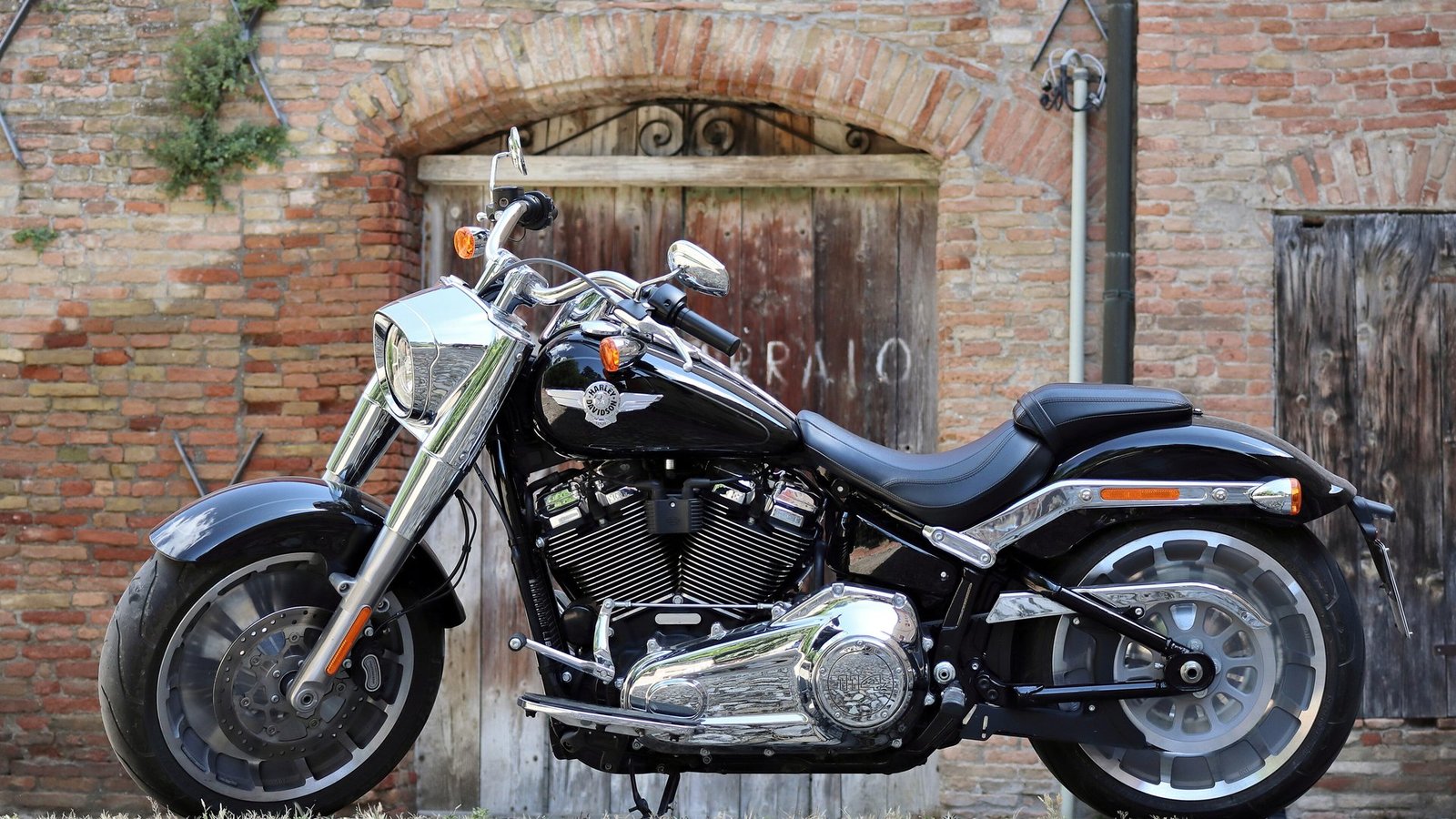
The model lineup also expanded. Production of the Softail FXST began in 1984, and Dyna line production started in 1991. Willie G. Davidson led design of the Fat Boy, introduced in 1990.
Manufacturing grew too. An assembly plant opened in Kansas City, Missouri, in 1998. Plant footprint now matters less to most riders than the product, but it shows the company’s expanding production base.
2000 to Today: Twin Cam, Revolution, and Milwaukee-Eight
Racing stayed part of the story into the new century. Scott Parker won his first AMA Grand National Championship in 1988. He won 9 championships within the 11 seasons from 1988 to 1998.
Parker left the sport with 94 career victories, an all-time record that still stands, after his final victory at Springfield, Illinois, in 2000. For fans of the brand, that record is one of the most cited racing numbers in the company’s history.
The modern engine families are easier to compare side by side:
| Engine | Displacement | Key detail |
|---|---|---|
| Twin Cam | 88 cubic inches at first, later 110 cubic inches | Displacement grew over its run |
| Revolution Max | 1250cc and 975cc | Revolution V-Twin made 115 hp at 8200 rpm with 11.3:1 compression |
| Milwaukee-Eight | 107 and 114 cubic inches at first, now 121 cubic inches in regular production | Engine family introduced in 2017 |
The Revolution V-Twin was developed with the assistance of Porsche. The Milwaukee-Eight family followed in 2017. If you are shopping for a newer Harley, the table is a quick way to see how the displacement options differ between families.
Note that the Revolution Max and the Milwaukee-Eight differ in how the company labels displacement. The Revolution Max uses metric figures, while the Milwaukee-Eight uses cubic inches. Check the specification sheet for the model you are considering, since the numbers above are from the engine families, not from any one motorcycle.
Legacy of the harley-davidson history
Within just a few years, the company claimed to be the world’s largest motorcycle manufacturer. Its footprint reached well beyond the US, with dealerships expanding into Europe and the Pacific Rim.
The founders built the company around three ideas: reliable motorcycles, good service, and knowledgeable salespeople. Those ideas remain the easiest way to judge a dealer or a bike today.
Design continuity also defines the brand. Willie G. Davidson set the standard for keeping the look that made H-D motorcycles popular, while continuing to move motorcycle design forward. The Knucklehead introduced the basic architecture for all future air-cooled V-Twin Harley-Davidson engines.
The first V-twin engine set a template for engine design that continues today.
The company’s community is part of its legacy too. Dorothy “Dot” Robinson was the first woman to win the Jack Pine enduro. She co-founded the Motor Maids, the first national women’s motorcycle club, and the club is still active today.
Other people shaped the company’s daily work. Crystal Haydel, one of the first women to work at Harley-Davidson, was a member of the Board of Directors by the time she died in 1949. Howard “Hap” Jameson met co-founder Arthur Davidson in 1911 and started at the company in 1912.
During World War II, the company supported the allied military while also keeping its civilian business alive. That balancing act was a recurring theme across the company’s history.
Did You Know
Dealers and riders picked up nicknames for the company’s bikes. The factory racing team was known as The Wrecking Crew, and its bikes were nicknamed hogs after its pig mascot. The company also coined the nickname Silent Gray Fellows for its dove gray, quietly reliable bikes.
The first production Harley-Davidson in 1903 had a 3-1/8-inch bore and a 3-1/2-inch stroke, yielding 7.07 cubic inches (116cc). By 1909 the first V-Twin had a displacement of 49.5 cubic inches and produced seven horsepower.
In 1942 the evaluation machines cost Uncle Sam $35,000 each. That price shows how expensive the military program was compared with the company’s civilian bikes.
The York facility grew large. York was once composed of 41 separate buildings covering 1.5 million square feet. Today it comprises two buildings totaling 650,000 square feet.
The York plant also had an overhead conveyor system several miles long. After implementing the M.A.N. (Materials As Needed) methodology in the early 1980s, the overhead conveyor was no longer needed and was removed.
Walter Davidson scored a perfect 1,000 points at the 7th Annual Federation of American Motorcyclists Endurance and Reliability Contest in 1908. Ole Evinrude, the inventor of the outboard motor, helped the early effort. AMF, the company that owned Harley-Davidson for years, was known to American consumers as a maker of bowling balls, but it was in fact a large, diversified manufacturer.
Bottom Line
The harley-davidson history is a story of persistence. The company started in a backyard shed, leaned on racing and military work, survived a difficult period under corporate ownership, and rebuilt itself through a 1981 buyback. Its engine families, from the Knucklehead to the Milwaukee-Eight, show how each generation built on the last.
If you own a Harley today, the history explains a lot about the parts you see. The engines, the design look, and the dealer network all trace back to decisions made over more than a century. When you research a model, check its specific specifications and the owner’s manual rather than relying on general history.
Sources
- The Early History of Harley-Davidson | Harley-Davidson USA
- History of Harley-Davidson Engine Types | Harley-Davidson USA
- Early Years of Harley‑Davidson | H‑D Archives | Harley-Davidson USA
- 10 People to Know from Harley-Davidson History | Harley-Davidson USA
- York Factory Story | Harley‑Davidson Archives | Harley-Davidson USA
- Harley-davidson Motorcycle History: History of Harley-davidson
- Family Affair | Cycle World | SEPTEMBER 1993
- Harley-Davidson engine timeline – Wikipedia